


By JASON WATKINS, 365 Staff Member
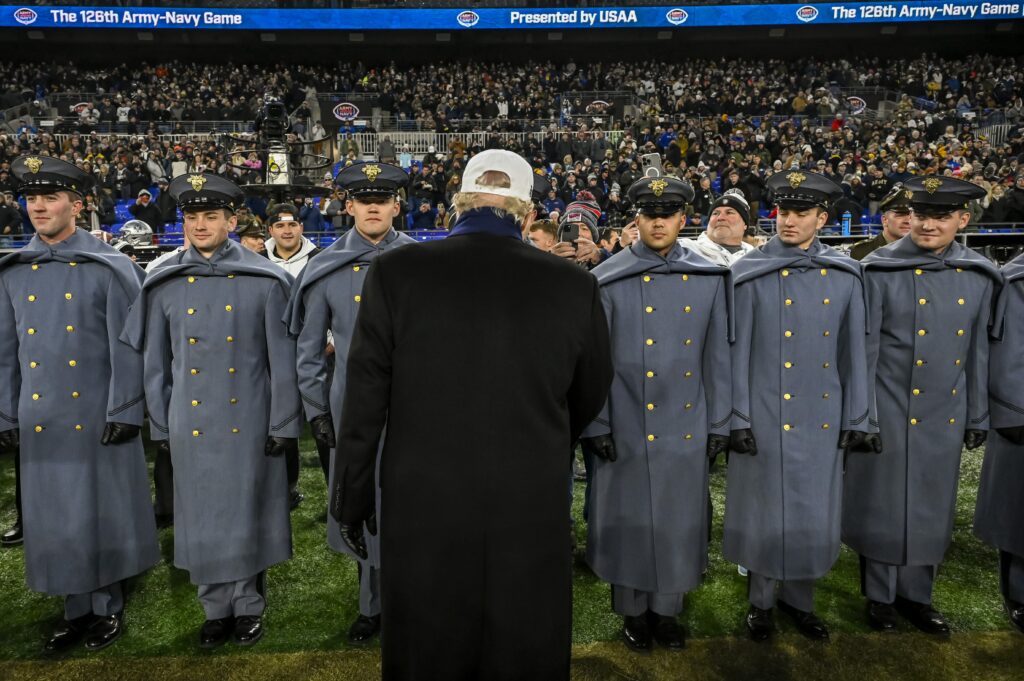
President Donald Trump did, in fact, sign an executive order Friday titled Preserving America’s Game, declaring it the policy of the United States that no college football game — especially College Football Playoff or other postseason games — be broadcast in direct conflict with the Army-Navy Game.
That sounds big.
It probably isn’t.
My hard lean is still this:
It’s a nothing burger.
At least right now.
That does not mean it is meaningless. And it definitely does not mean it cannot matter.
Because if this executive order winds up clarifying what actually has to be protected about Army-Navy — and what does not — then it may end up doing something useful for a sport that keeps finding new ways to make simple things dumber than they need to be.
What this is — and what it isn’t...
This is not Donald Trump walking into college football and fixing the playoff with the stroke of a pen.
This is not the White House suddenly becoming the sport’s scheduling czar.
And this is not some immediate solution to a current crisis.
The current playoff calendar is not actually colliding with Army-Navy. So if you want to roll your eyes at the size of the reaction here, go ahead. You are probably right to.
This executive order is much more about future leverage than present reality. It is aimed at what could happen next if the playoff expands, if more games are pushed deeper into December, and if television’s appetite for inventory keeps swallowing everything in sight.
That is what makes this worth paying attention to.
Not because it changes everything today.
But because it may expose that one of the sport’s favorite scheduling excuses was never as airtight as people made it sound.
Army-Navy is definitely worth protecting…
Let’s start here: protecting Army-Navy is fine.
Good, even.
It is one of the few events in this sport that still feels entirely like itself. It is bigger than rankings and brackets and TV windows and brand management. It deserves its own stage. It deserves not to be treated like just another inventory slot in a postseason television package.
So, sure, good for you, Mr. President.
Protect Army-Navy.
Nobody with a pulse around this sport should have a problem with that.
But there is a difference between protecting Army-Navy and pretending Army-Navy has to shut down an entire weekend.
And that difference matters.
Because for years now, a lot of people around the sport have talked as though the game functionally blocked off the whole Saturday — maybe even the whole weekend — from anything meaningful CFP-related. Like nothing could move. Like the calendar was boxed in. Like there was simply no room to do anything but wait.
But if what actually needs to be protected is Army-Navy’s traditional early-afternoon window on the second Saturday in December, that is a much smaller obstacle.
And if it is a smaller obstacle, then college football has had more flexibility here than it has admitted.
Which also means it has had fewer excuses.
This is not college football’s biggest problem…
Now, to be clear, I am not arguing that the playoff bye structure is the biggest thing wrong with college football.
It isn’t.
Not even close.
This sport’s biggest problems are much deeper than bracket design. The people whose labor makes the entire money machine run still do not have anything close to a real collective bargaining structure, a reliable arbitration system, or any coherent protection from the universities, coaches, conferences and NCAA figures forever trying to claw back even the smallest amount of leverage players have gained over their own name, image and likeness.
If you want to talk about what truly ails college football, start there.
Start with governance. Start with labor. Start with the fact that everybody gets rich except the people expected to risk the most.
That is the real stuff.
What I am talking about here is not the sport’s deepest sickness.
It is one of its most obvious self-inflicted problems.
And right now, the playoff’s current reward system belongs near the top of that list.
The CFP bye hasn’t been helpful…
Through the first two years of the 12-team playoff, seven of the eight teams that earned first-round byes lost their first game.
Seven of eight.
At some point, that stops looking like bad luck and starts looking like the bracket telling you something.
For all the language around how valuable those byes are supposed to be, the results keep pointing in the other direction. The teams that “earn” the reward have too often looked like they are being handed a complication.
Not because they are worse.
Because they are waiting.
And the teams they face are not.
Rust is the obvious answer…
Why is this happening?
Rust.
That’s not the only explanation for every game. Football is too messy for that. Matchups matter. Health matters. Seeding is never perfect. Some of the lower-seeded teams coming through the first round were obviously better than their number suggested.
All of that is true.
But rust is still the clearest and most obvious explanation for why the so-called advantage keeps looking like a trap.
We have seen this before.
In the four-team CFP era, top teams often came out flat on New Year’s Day after a long layoff. This is not new. The difference is that the rust used to be more evenly distributed. The top teams were all waiting. They were all dealing with the same stop-start rhythm. They all had to rediscover game speed at roughly the same time.
That is not what happens now.
Now, the teams with byes sit around while their opponents go play a real postseason game. The non-bye teams get to work through sloppiness under live bullets. They get a chance to rediscover timing and urgency and pace against somebody trying to end their season.
Then they turn around and play a conference champion that has been hearing for weeks what a blessing the bye is.
That is not much of a blessing.
That is a trap dressed up as an advantage.
The CFP’s “bye week” isn’t really a bye week…
And the sport has done itself no favors with the way it talks about this.
People keep calling it a bye week.
It isn’t.
An in-season bye week is a week between games. That is what fans and coaches think of when they hear the word. A breather. A reset. A chance to get healthy, self-scout and get back to work.
That is not what the CFP created.
What the CFP created is a long layoff.
A conference champion finishes its title game, disappears for weeks, and then has to ramp back up immediately against an opponent that already got its playoff kinks out of the way the week before.
So when people act confused about why the teams with byes keep looking a little clunky early, I’m not sure what there is to be confused about.
Football teams need to play football.
This is where the Army-Navy executive order may actually matter…
And this is the only reason I think Trump’s executive order could wind up being more than ceremonial nonsense.
If this order helps clarify that Army-Navy only requires protection for its actual window — not an entire Saturday frozen in amber — then the sport may finally have to reckon with the fact that its playoff calendar has been dragging more than it has to.
That matters because so many people around college football, from fans to media to the people running it, want to see a limit on how far into the new year the season extends.
That is a fair complaint.
The season runs too long. The postseason takes too long. There is too much dead space. Too much waiting. Too much pretending every piece of bloat is unavoidable because of tradition or television or academic concerns or whatever else the sport uses that week as cover.
If the playoff can start earlier without stepping on Army-Navy — and it sure looks like it can, if what needs protecting is the window rather than the whole weekend — then the sport has room to tighten this thing up.
And it should.
A better calendar solves more than one problem…
A tighter playoff calendar would help with more than just the bye issue.
It would help get the season done before the second week of January is over.
It would help the sport stop dragging its showcase event so far into the new year that it starts feeling disconnected from the season that produced it.
It would help with transfer portal timing, which remains one of the dumbest, most self-sabotaging calendar problems in modern sports.
It would help with roster management, too, especially for the teams still playing while everybody else is already maneuvering for the offseason.
And for those who still want to pretend the academic calendar matters when convenient, a shorter and cleaner postseason should make more sense there, too.
This is not hard.
The sport has just gotten used to pretending it is.
So, yes, this is probably a nothing burger…
That remains my hard lean.
Trump did not save college football on Friday.
He did not rescue the postseason from itself.
He did not solve the governance crisis, the athlete-rights problem, the NIL mess, or the sport’s total inability to create a system that treats players like anything other than assets until they ask for a say in the process.
None of that changed.
But this executive order may still matter a little.
Because if it pushes people to understand that protecting Army-Navy does not have to mean preserving an unnecessarily bloated playoff calendar, then it could help move the sport toward something smarter.
Maybe that means starting the playoff earlier.
Maybe that means shrinking the layoff for teams that earn byes.
Maybe that means rethinking whether byes belong in this format at all.
Whatever the answer, the current setup is telling us something.
Seven of eight bye teams losing their first game is not something you shrug off forever.
At some point, it becomes evidence.
So yes, this is probably a nothing burger.
But if it helps college football stop hiding behind a scheduling assumption that may not be true, and if it helps push the sport toward a postseason calendar that makes more sense, then Trump may have helped save college football a little bit.
Not the way he thinks.
But maybe in one of the ways the sport actually needs.