
It came as no surprise when we learned on Wednesday that the NCAA had denied Ole Miss’s appeal for Trinidad Chambliss’s sixth-year eligibility waiver. This waiver, rejected by the NCAA’s athletics eligibility subcommittee, was based on a medical hardship stemming from his second season at Ferris State in 2022. The initial request for Chambliss’s waiver was denied back on January 9, 2026.
While it may seem that Chambliss has lost this particular battle in the appeals process, he has not given up the war for his eligibility. His legal team is now shifting focus to seek an injunction—not to rewrite the rules but to enforce them.
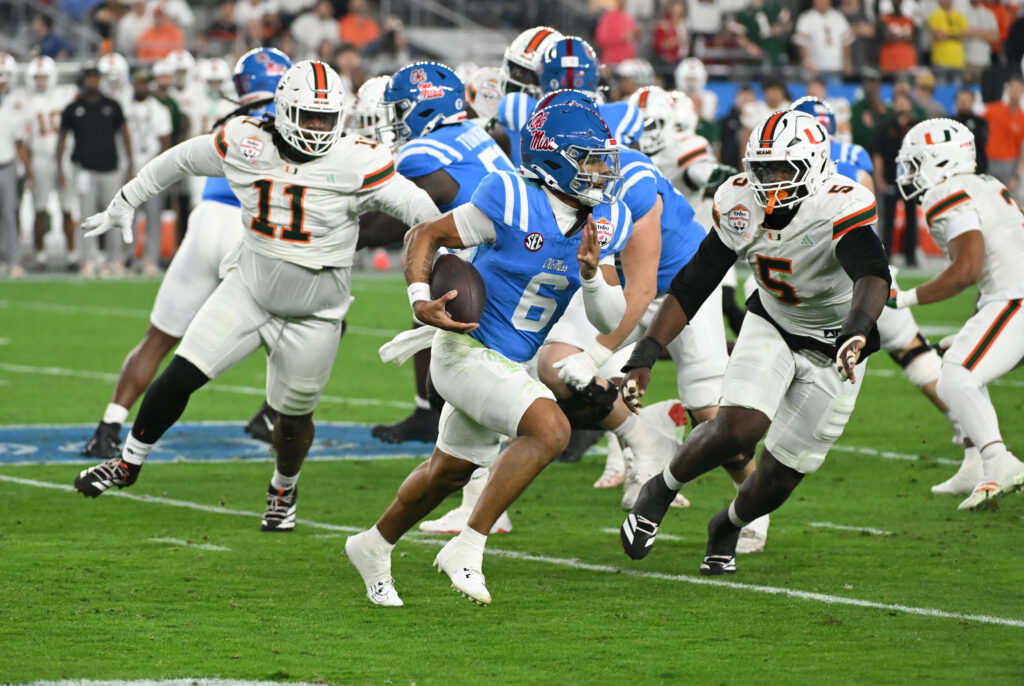
In a county better known for its fertile soil than federal injunctions, where agribusiness and sweet potatoes drive the local economy, a different kind of hope will be cultivated on February 12. Inside the Calhoun County Courthouse in Pittsboro, MS, Ole Miss quarterback Trinidad Chambliss will ask a Mississippi judge to do what the NCAA would not: acknowledge that a season lost to documented medical hardship should not jeopardize his future.
Every now and then, I draw upon my brief stint in law school and my once-aspiring desire to become a lawyer. The crux of this matter is that while the NCAA insists that Chambliss was not denied an opportunity to compete in 2022, the evidence—medical records, photographs, and statistics—tells a different story that substantiates his claims. He never dressed for games, never took a snap, and never stepped onto the field. This is not an attempt to exploit loopholes; rather, he suffered from severe and debilitating medical conditions that were thoroughly documented at the time and verified by his treating physician. I may not have finished my law degree, but the first year of law school had me indulge in enough torts, contracts, and civil procedure to know that despite what the NCAA may lead the outsiders to believe is legit, if you dig deeper, the reality is it is a sinking ship that wouldn’t hold up in court.
This situation is grounded in clear facts rather than speculative circumstances with gray areas. Yet, despite substantial proof supporting his case, the NCAA continues to deny the waiver—not based on evidence but seemingly without regard for scrutiny or accountability regarding their actions and motives.
It is clear that the NCAA has opted to disregard both medical records and its own established precedents concerning hardship cases. In doing so, the organization has leaned on technicalities while neglecting the complexities of individual circumstances.This issue transcends mere eligibility; it raises critical questions about whether the NCAA will be held accountable when its own rules, precedents, and medical standards are overlooked.
Just down the road in Vardaman—self-proclaimed sweet potato capital of the world—farmers understand that timing, documentation, and results are paramount. The farmers of Calhoun County know this truth well: if a crop fails to emerge from the ground, it cannot be counted as a harvest. If adverse weather devastates a season, one cannot simply pretend that a yield exists because seeds were sown. Yet this is precisely what the NCAA expects us to accept in justifying their decisions based solely on what is “technically” available on paper. This disconnect between documentation and reality is why this case has escalated beyond compliance offices and into courtrooms.
Why This Injunction Matters
Chambliss is not seeking preferential treatment or a ruling on the entire case—not at this stage. Instead, he requests an injunction that would allow him to compete while legal proceedings unfold.
In straightforward terms, if granted, this injunction would enable him to play while the NCAA’s decision undergoes rigorous examination—not only in accordance with the letter of the law . Which would force the NCAA to apply its rules consistently and fairly.
Chambliss is more than just a theoretical roster piece or a future prospect; he is a dynamic player whom the Rebels anticipate will make an impact next season—a player equipped with experience, agility, and potential within an evolving offense. Losing him represents more than merely diminished depth; it signifies lost opportunity—the very thing the NCAA claims he was never denied.
A Broader Reckoning for the NCAA
This case extends beyond one quarterback; it confronts an organization that continues to assert authority even as courts increasingly challenge its decisions. It exposes an appeals process seemingly crafted to uphold precedent only when advantageous for the NCAA. Furthermore, it scrutinizes medical hardship rules that exist on paper yet falter under real-world application.
The NCAA asserts that its decision aligns with established rules and precedents. Now Chambliss’s legal team—and a Mississippi judge—will determine whether that assertion holds up under oath rather than hidden behind the NCAA’s judge-and-jury ways.
Back in Calhoun County, even farmers recognize an undeniable truth: you cannot fabricate a season or ignore unfavorable weather conditions. You do not penalize individuals for circumstances beyond their control. On February 12th, in a courthouse surrounded by farmland rather than luxury boxes, Trinidad Chambliss will seek nothing more than fairness and common sense in his pursuit of justice. The NCAA may have already made its decision. We will see whether real justice, like a good Mississippi harvest, is still rooted in reality.