

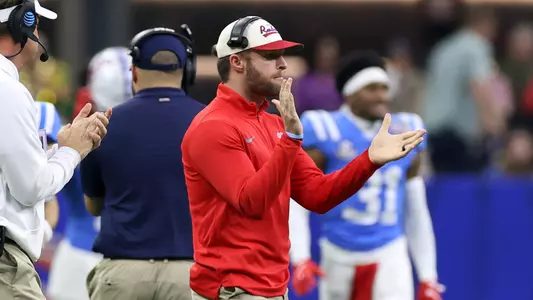
Ole Miss offensive coordinator John David Baker
When No. 9 Ole Miss hosts No. 13 Missouri on Saturday at Vaught-Hemingway Stadium (2:30 p.m. CT, SEC Network), one of the defining storylines will be the clash between the Rebels’ high-powered, pass-heavy offense and the Tigers’ stout, run-stuffing defense.
Both teams sit at 2-1 in the SEC with College Football Playoff implications on the line. Ole Miss (4-1) averages 38.8 points per game (21st in FBS) and 433.8 total yards per game. Missouri (5-1) allows just 17.7 points per game and ranks among the national leaders in several defensive categories, particularly against the run.
Ole Miss Offense: Efficient, Explosive Through the Air
The Rebels’ attack centers on quarterback Trinidad Chambliss, who has completed 122 of 174 passes (70.1 percent) for 1,435 yards, 11 touchdowns and four interceptions. He has also added 113 rushing yards and five rushing scores, accounting for 16 total touchdowns.
Ole Miss ranks 15th nationally in passing yards per game at 300.6 and averages 8.2 yards per pass attempt. The unit converts third downs at 43.1–43.9 percent and is perfect in the red zone (20-for-20 scoring opportunities, with 18 touchdowns). Overall, the Rebels average 6.47 yards per play.
The ground game has been more modest: 133.2 rushing yards per game (around 105th nationally) on 4.4 yards per carry, with 12 rushing touchdowns. Running back Kewan Lacy leads with 230 yards and five scores on 46 carries (5.0 average) despite limited availability in some games. Makhi Frazier has added 153 yards.
Wide receiver Deuce Alexander paces the receiving corps with 32 catches for 503 yards and five touchdowns. The Rebels feature multiple contributors with at least seven receptions each, creating a spread attack that stresses secondaries.
Ole Miss scored 42 points in the first half alone in its most recent outing, a 52-17 win at Vanderbilt, finishing with 409 total yards (196 rush, 213 pass).
Missouri Defense: Elite Against the Run, Disruptive Overall
Missouri’s defense, coordinated by former Ole Miss assistant Corey Batoon, has limited opponents to 302.5 yards per game and just 17.7 points per game. The standout unit is the run defense: 78.3 yards allowed per game (eighth nationally) on roughly 2.5 yards per carry. In recent games, the Tigers held Florida to 42 rushing yards and Texas A&M to 27.
Against the pass, Missouri allows 224.2 yards per game. Opponents complete 56.7 percent of passes for 6.6 yards per attempt, with the Tigers recording six interceptions. The front has produced 18 sacks (including 13 in the second half, among the national leaders) and ranks high in havoc rate.
Linebacker Nicholas Rodriguez leads the FBS with 63 tackles. Edge rusher Daeden Hopkins has 7.0 sacks and 7.0 tackles for loss. The secondary features multiple playmakers, including former Ole Miss defensive back Chris Graves Jr. (seven pass breakups). Missouri’s success rate allowed sits at 34.5 percent (top 20 nationally), and the Tigers have been especially strong on third and fourth downs.
In its last two games, Missouri held Florida to 17 points and 325 yards, then blanketed Texas A&M for just six points and 216 yards.
The Matchup Dynamics
Ole Miss’s strength lies in the passing game and red-zone efficiency; Missouri’s is stopping the run and generating pressure. The Rebels rank outside the top 100 in rushing offense, while the Tigers rank in the top 10 against the run. That sets up a potential chess match: Can Ole Miss establish enough of a ground presence (or use designed quarterback runs) to keep Missouri’s defense honest and open intermediate and deep throws for Chambliss and Alexander?
Conversely, Missouri’s secondary and pass rush will be tested by Chambliss’s accuracy and the Rebels’ tempo and multiple receivers. Ole Miss has allowed five sacks all season; Missouri has racked up 18. The Tigers’ ability to force third-and-long situations could be decisive, as Ole Miss converts those at a solid but not elite rate.
Missouri leads the all-time series 7-1 and has won the last meeting (38-27 in Oxford in 2019). Ole Miss has not beaten the Tigers since 1974. With both teams ranked in the top 15 and several former Rebels now starring for Missouri (including quarterback Austin Simmons and receiver Cayden Lee), the stakes—and the statistical contrasts—are clear.
Saturday’s outcome will hinge largely on whether Ole Miss’s aerial attack can overcome Missouri’s physical, disciplined front and secondary, or whether the Tigers’ defensive identity can slow one of the SEC’s more productive offenses.